If I shall exist eternally, how shall I exist tomorrow?
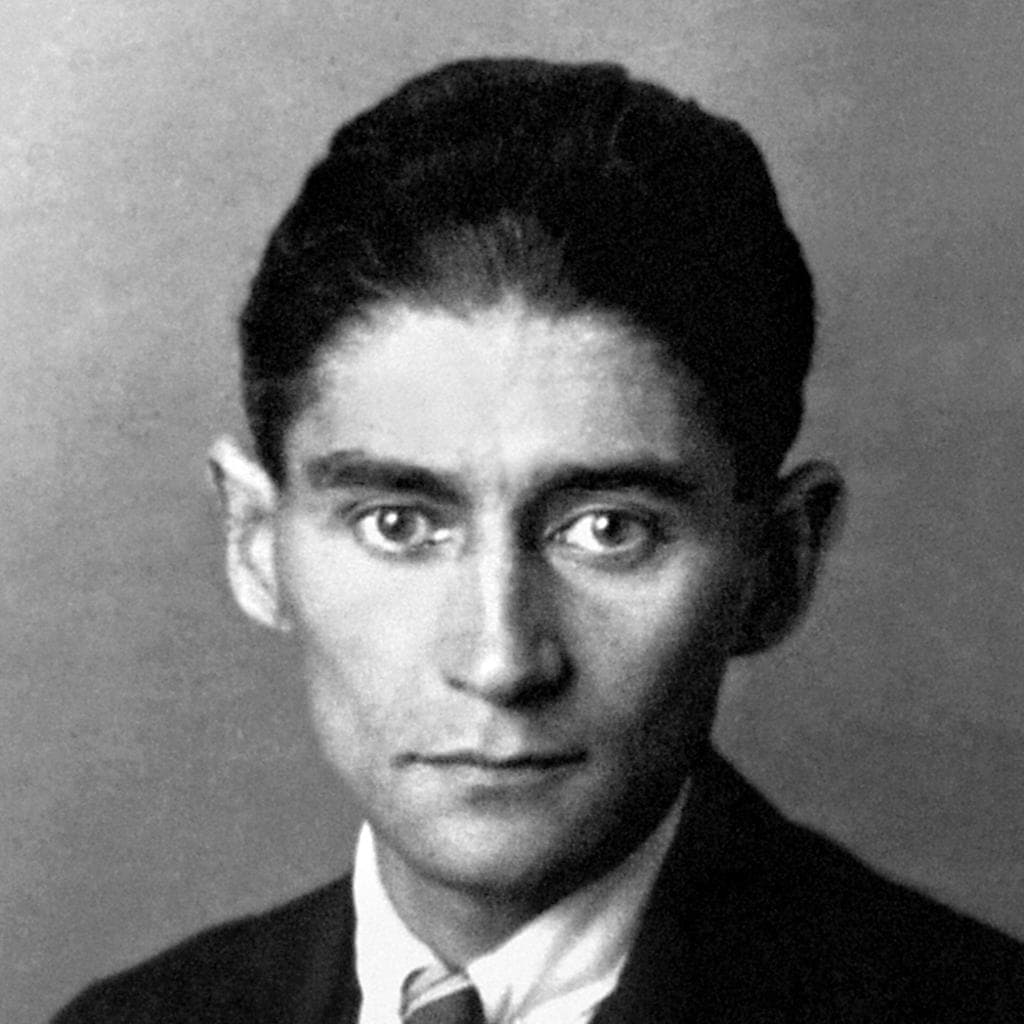
Franz Kafka
Franz Kafka (1883 - 1924) is a Jewish Czechoslovakian who wrote in German, and who ranks among the twentieth-century's most acclaimed writers. His works evoke the bewildering oppressiveness of modern life, of anxiety and alienation in a world that is largely unfeeling and unfamiliar. Although most of his work was published posthumously, his body of work, including the novels 'The Trial' (1925) and 'The Castle' (1926) and the short stories including 'The Metamorphosis' (1915) and 'In the Penal Colony' (1914), is now considered among the most original in Western literature.
Franz Kafka was born on 3rd July 1883 in Prague, the eldest of six children. He had three younger sisters and two younger brothers, Georg and Heinrich, who died at the ages of fifteen months and six months, respectively, before Franz was seven. On business days, both parents were absent from the home. His mother helped to manage her husband’s business and worked in it as many as 12 hours a day.
Kafka’s first language was German, but he was also fluent in Czech. Later, Kafka acquired some knowledge of the French language and culture and one of his favorite authors was Flaubert. From 1889 to 1893, he attended the Deutsche Knabenschule, the boys’ elementary school in the Masný Street.
After elementary school, he was admitted to the rigorous classics-oriented state gymnasium, Altstädter Deutsches Gymnasium at Old Town Square, within the Kinsky Palace. This was an academic secondary school with eight grade levels, where German was also the language of instruction. Kafka’s education was limited to the period up to his Bar Mitzvah celebration at thirteen. He completed his Maturita exams in 1901. After his Bar Mitzvah, Kafka loathed having to go to the synagogue with his father and limited his attendance to four times a year at Jewish holidays.
On 1 November 1907, he was hired at the Assicurazioni Generali, a large Italian insurance company, where he worked for nearly a year. On 15 July 1908, he resigned, and two weeks later found more congenial employment with the Worker’s Accident Insurance Institute for the Kingdom of Bohemia.
In 1917, Kafka began to suffer from tuberculosis, which would require frequent convalescence during which he was supported by his family, most notably his sister Ottla. From 1920 Kafka developed an intense relationship with Czech journalist and writer Milena Jesenská. In July of 1923, throughout a vacation to Graal-Müritz on the Baltic Sea, he met Dora Diamant and briefly moved to Berlin in the hope of distancing himself from his family’s influence and concentrate on his writing. In Berlin, he lived with Diamant, a 25-year-old kindergarten teacher from an orthodox Jewish family, who was independent enough to have escaped her past in the ghetto. She became his lover, and influenced Kafka’s interest in the Talmud. Kafka’s tuberculosis worsened in spite of using naturopathic treatments. He returned to Prague, then went to Dr. Hoffmann’s sanatorium in Kierling near Vienna for treatment. He died there on 3 June 1924, apparently from starvation.
His novels, The Trial (1925), The Castle (1926) and Amerika (1927), along with his short stories including The Metamorphosis (1915) and In the Penal Colony (1914), make up a body of work that is now considered among the most original in Western literature. Most of Kafka’s output, much of it unfinished at the time of his death, was published posthumously.
You can read JP O’Malley’s excellent article on Kafka here: http://bit.ly/2XLHZLD
Essential cookies enable basic functions and are necessary for the proper function of the website.
Name
Description
Duration
Cookie Preferences
This cookie is used to store the user's cookie consent preferences.
30 days
These cookies are used for managing login functionality on this website.
Name
Description
Duration
wordpress_logged_in
Used to store logged-in users.
Persistent
wordpress_sec
Used to track the user across multiple sessions.
15 days
wordpress_test_cookie
Used to determine if cookies are enabled.
Session
Statistics cookies collect information anonymously. This information helps us understand how visitors use our website.
Track user interactions on your site with to optimize engagement and conversions.
Name
Description
Duration
_monsterinsights_uj
Stores anonymized user navigation history on the website, including visited URLs, page titles, and referrer information. It helps site owners analyze user journeys for improved site experience and analytics.
365 days
Marketing cookies are used to follow visitors to websites. The intention is to show ads that are relevant and engaging to the individual user.
Facebook Pixel is a web analytics service that tracks and reports website traffic.